Saturday, March 19, 2011

WHY DO WE HATE THEM

0 comments
Anis Hamadeh, March 19, 2011
http://www.anis-online.de/1/essays/25.htm


Editorial Note The German version of the following piece
by Anis Hamadeh,
a German artist and writer, was published at
http://www.nrhz.de/flyer/beitrag.php?id=16285
TheEnglish
version, also written by Anis Hamadeh,is published here with
his permission.It may be copied/published/distributed freely.


There are far more than 100.000 Google entries for "Why do they hate us?". This question has engaged US Americans since 9/11 and Noam Chomsky provided some sound answers in a video shown on Youtube (www.youtube.com/watch?v=6pfcW0_sSuw). "Why do they hate us" gained new momentum with the beginning of the Arab Revolution, as certain discrepancies became transparent concerning our Western attitude towards Arab countries. Yet the hate question is of special significance for another reason, too, one that goes almost unnoticed: it reflects the discourse of the ruling in which hate is a sentiment exclusively reserved for the antagonist, i.e. the enemy. The underlying deeper question is: why do we hate them?

In the original German version of the article at hand, - published by the Neue Rheinische Zeitung (www.nrhz.de) on March 16 -, mention is made of Otto von Bismarck and his strategy of unifying the Germans by providing a common enemy to them - France. Later, Adolf Hitler continued the strategy and introduced a new object of hatred to establish a strong in-group feeling among his fellow countrymen, namely the Jews. Anti-Semitism was, in fact, a traditional European idea that came up in the time of the crusades. The Nazis carried it to extremes, and added the communists, the Sinti and Roma, free artists, homosexuals and genetically deviant people. All those were permissible to be hated. In this way, the Germans developed their national identity: 'we are not them'.

'Enemy thinking', both as a method and as an unconscious habit has severe negative effects on one's own society and on others, as it uses the notion of "we against them" to build an in-group feeling, a strong We.

Unfortunately, the story of hate continued even after the nightmare of World War II, and not only in Germany. As soon as the Nazi enemy was overcome, communism took its place, defining a new supra-national entity: the West or the "free world".

The issue of 'enemy thinking' did not reach the top of the school curricula, and politicians and media would not refrain from institutionalizing it. Of course, this behavior can also be found in non-Western societies, but this fact does not redeem our own behavior for which we are fully responsible. A bank robber will hardly convince a judge by asserting that there are far worse bank robbers around in other areas of the planet.

But what about 1989, when the Berlin Wall fell and the Soviet Union disappeared? People had discarded enemy thinking by then, abolished the NATO, and had gone back to reason, hadn't they? Not at all. It was not long until a new enemy was found, another dormant one, saved for a rainy day. Because we got hooked on the 'enemy', like a heroin addict gets hooked on the drug.

Similar to the case of anti-Semitism, the enmity toward the current antagonist, Islam and the Orient, has historical roots as reference points. And like in Nazi ideology, we have additional secondary enemies: this or that dictator, China, some internal suspects etc. Yet, after 9/11 (with all its open questions), the "free world" has zeroed in on Islam, covering the respective Arab and Muslim countries with wars of aggression (as opposed to defensive wars) and with threats, while Muslims in our own Western societies are being "critically" eyed.

So why do we hate them? Because, without an enemy we hardly have an identity. It is an expression of decadence by societies that persistently refuse to learn from history. The peak is reached with the phantasm of a "Christian Jewish tradition", a new fashionable term in the German discourse, probably not restricted to Germany. It is a kind of trick to get the former enemy into the boat against his successor. The context was understood even by the Central Council of the Jews in Germany, an institution that is not generally regarded as being progressive and one that much too often has appeared as an apologist for the state of Israel, a state seemingly obsessed by the use of violence.

In January 2011, CCJG Vice President Salomon Korn said in an interview that the emphasis on "Christian Jewish roots of the Occident" might be agenda-motivated, in the sense of integrating the Jews in a common front-line against Muslims. Such "embraces" should be regarded with caution, according to Korn. Another trick is to regard the genocide of the Jews as unique in a way that it leaves the historical frame, becoming an incomparable act, so that we cannot remotely be in danger of committing such a crime ourselves. What we do in our war zones could never be so cruel.

But do we really hate Islam so much? Is it not an exaggeration? Some insignificant or casual remarks on Fox News, CNN, and in the mainstream media? This won't make the world stop, will it? Isn't it rather like in sports? Be a sport! - The thing is that "Islam" and "Arabs" are only on-the-surface issues. It really is about the eternal and inevitable enemy that we create and maintain - and kill. We need him, because we have no identity without him.

Take Iran, a country that is targeted and threatened by us. Is it because of the bomb that Iran does not possess while Israel possesses it? Or is it because "they hate us"? In 1953, the CIA was instrumental in toppling Prime Minister Mossadegh and supporting the Pahlevi reign until the theocratic revolution which - closing the circle - has been serving as a convenient setting for Western enemy thinking ever since. And why has the USA to mess around in Palestine, in Iraq, in Afghanistan and Pakistan, with a long trail of blood? Is it not an addiction? An obsession?

Of course, not everybody subscribes to enemy thinking. Even the mainstream media at times broadcasts and publishes sophisticated and fair contributions within its limits. So there is hope. Yet the problem remains: we hate systematically, up to killing. Today we lead and support wars of aggression, jettison our own values and fail to adequately acknowledge our responsibility. Even after Hitler. This is the real issue. We call it "freedom", but it is not freedom. Free are those who are sensitized, who know the value of life and who do not need an enemy. Those who recognize self-realization to be the meaning of life, the pursuit of happiness. Those who understand that art has a meaning and that culture enriches the world. Those who have a self-identity and are proud of it.

It is a long way there, still. For the schools, the parental homes, the cliques, the media, the political parties, and the corporations.

In Egypt, tens of millions of people stood up for change. We can learn a lesson from that.


Anis Hamadeh is a German artist with Arab roots, MA in Islamic Studies, author of "Islam für Kids" (345 pp, in German), website: www.anis-online.de/index_engl.htm

WEST'S SELECTIVE CONCERN FOR LIBYAN REBELS

0 comments
By Gulamhusein Abba


Principally the US, UK and France have started taking “all measures necessary” to stop Libya, a duly constituted, independent, sovereign nation from, in effect, putting down a rebellion by a few Libyan tribes who were determined to effect a regime change.

At time of writing, according to news reports, 112 Tomahawk cruise missiles were fired from American and British ships and submarines. French fighter jets fired salvos, carrying out several strikes in the rebel held east. RAF Tornados, flying from Norfolk, bombed targets near Tripoli. Tomahawk missiles fired from a Royal Navy submarine hit targets around the coastal cities of Tripoli and Misrata.

This pounding of Moammar Gadhafi’s forces and air defenses with cruise missiles and air strikes hit 20 to 22 targets leaving targeted tanks and jeeps burning and causing “various levels of damage”. Libyan state TV reported that civilian areas of Tripoli as well as fuel storage tanks supplying the western city of Misrata hat been hit. A Libyan government spokesman claimed that many civilians had been hurt and ambulance crews had been doing their best to save as many lives as they could.

The overriding reason for this essentially western military intervention is claimed to be saving the lives of innocent Libyans being “massacred” by Gadhafi. The justification was that the world could not stand idly by when such a massacre was being carried out.
No figures are available as to the number of people that have been killed by Gadhafi forces.

This military intervention raises questions about international law, more particularly as to how far can a government go in putting down a rebellion and when any outside power or coalition of powers or even the UN can throw in its weight to support one side or the other in what is essentially a civil war raging in an independent sovereign nation.

Without going into the legal and political implications, a couple of puzzling and disturbing questions arise.

If the intervention was because, as president Obama said, Gadhafi was shooting at his own people, what about Yemen and Bahrain? Are not those governments also firing “on their own people”? Strikingly absent is any real harsh denunciation or even criticism of these two governments.

And where were these “world leaders”, who today are carrying out strikes against Libya, when China was subjugating and colonizing Tibet or putting down the uprising in Tiananmen Square, shooting their own people? And why did these powers not intervene when Israel was firing mortars and missiles and dropping mega bombs, in wave after wave of “operations” bearing fancy names against Gazans who were trying to overthrow Israel’s long running, illegal and brutal occupation of their land?

Also, Obama has warned Libya that it will face the wrath of the combined forces of US, UK, Franc and several other members of the latest “coalition of the willing” if it prevents humanitarian aid reaching Libya. Fair enough. But why was such a warning not given to Israel when it prevented ships carrying humanitarian aid from reaching Gaza?

Is it any wonder that the rest of the world (5 countries - Russia, China. India, Germany and Brazil - abstained from the UN vote) looks with suspicion about the real motives of this selective concern for the rebellious tribes of Libya?

Further, the claim that the reason for and purpose of the intervention is solely to protect the ‘innocent Libyan civilians’ who are being “massacred’ by Gadhafi becomes suspect when persons like the former British ambassador to Libya, Oliver Miles says it was clear that the long-term aim of the military action by the latest ‘coalition of the willing’ was to overthrow Colnel Gadhafi, and the British Foreign Secretary, William Hague says he cannot see a future with Colnel Gadhafi in charge. He told Sky News bluntly “We want him to go”.

The US will do well to remember that not all enemies of our enemy are necessarily our friends and that sometimes the one chosen to replace an undesirable ruler turns out to be worse!


Thursday, March 3, 2011

MURDER MOST FOUL

0 comments
Time for Muslims to save the essence of Islam

By: Gulamhusein A Abba


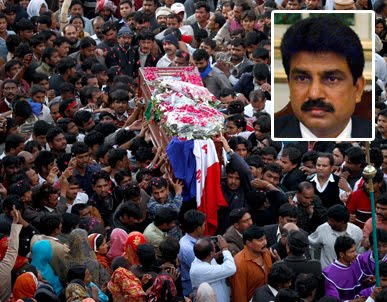
I am a Muslim. I hold Prophet Muhammed in high esteem and have great admiration, respect and regard for him. But that cannot and does not prevent me from condemning in the strictest terms possible the murder on Wednesday, February 2, of the only Christian federal government minister in Pakistan for allegedly blaspheming Islam.

Shahbaz Bhatti was a Minister for Minorities in the Government of Pakistan.. He was a prominent opponent of the blasphemy law in Pakistan that mandates the death penalty for insulting Islam and or Prophet Muhammed.. He is the second senior official this year to be murdered for opposing that law. Provincial governor Salman Taseer was shot dead by his own bodyguard just a month earlier, in January.

Neither Shabaz nor Salman blasphemed. They merely opposed the blasphemy law as it stood and asked for amendments to it.. Even if they had blasphemed, that does not allow private individuals to take the law into their own hands and kill them. There is the blasphemy law. They could have been tried under it.

I go further and say that even if they had been found guilty under that law, it would have been disgraceful, to say the least, to put them to death for that..

I understand that religion is a sensitive subject. People who will not ordinarily harm a fly will die, and kill, for religion!

But Islam is not served by putting blasphemers to death. I am certain that were Prophet Muhammed alive today, he too would have opposed the death penalty mandated under this particular law in Pakistan .

The self styled protectors of Islam who put Shabaz and Salman to death bring not glory to Islam but ridicule and contempt.

In this time and age, putting people to death by stoning, or in any other manner, for any crime, is archaic.

What Muslims need to do understand that the way to counter blasphemies is to make greater efforts to spread the truth about Islam and Prophet Muhammed. The weapon against untruth is neither guns nor the guillotine but truth.

When Gandhi started the Quit India movement to rid India of British rule, I supported and participated in the movement. However, I also supported and worked for the creation of Pakistan.

Just as my love and respect for Islam and Prophet Muhammed does not prevent me from condemning the assassins who killed Shabaz and Salman, my having worked for the creation of Pakistan does not prevent me for censuring the Pakistani Government for having a law that mandates death for insulting Islam or speaking ill of Prophet Muhammed, and more particularly for the way it has handled the cases of Shabaz and Salman.

Shabaz was very aware of the assassination of Salman. He had received death threats. He knew his life was in danger. He even made a video about it. The Government had been informed about the danger to his life. Yet he was shot eight times, in broad daylight, in his car near his home as he was heading to work in Islamabad .

The windshield of Shabaz's car had four or five bullet holes. Blood covered the back seat. According to his driver, Gul Sher, a white car stopped near the car carrying Shabaz near a crossing. One of the four people sitting in the car got out, came in front of the car and opened fire from a Kalashnikov.

Surely it was the responsibility and the duty of the Government to have seen to it that Shabaz had protection as he travelled to work. But there was no security there whatsoever. Just Shabaz and Gul Sher.

Chilling is the fact that Salman's killer was lionized in Pakistan. Huge processions were taken out in his honor. Shockingly, lawyers, in their black robes, joined in.

True that government officials condemned Mr. Bhatti's killing Wednesday. Prime Minister Yusuf Raza Gillani condemned the killing and ordered the Ministry of Interior to investigate.

But, after the Punjab province governor was killed in January, Gillani and other politicians disowned advocacy of reform of laws that make insulting Islam a capital crime. In fact, Sherry Rehman, a ruling party lawmaker who had proposed legislation to reform the anti-blasphemy laws, withdrew the bill, saying the party did not support it. The government of President Asif Ali Zardari has repeatedly said it would not change the blasphemy law, and officials have distanced themselves from anyone calling for amendments

And, significantly, neither President Asif Ali Zardari nor Prime Minister Gillani attended Salman's funeral.

These two assassinations represent a severe blow to Pakistani liberals, who are increasingly being silenced by Muslim hard-liners willing to use violence against those who do not share their harsh views.

Farahnaz Ispahani, a spokesman for President Asif Ali Zardari, said in a statement, "The time has come for the federal government and provincial governments to speak out and to take a strong stand against these murderers, to save the very essence of Pakistan."

If the Government of Pakistan is serious about dealing with the Taliban and violent extremist and radical Islamists, it must do more than issuing formal condemnations of such killings and ordering investigations.

For starters, the government must systematically arrest those who incite and praise murderers.

For its part, Mr. Zardari's Pakistan People's Party (PPP), which has not championed the views of Shabaz or Salman, needs to mobilize its large voting base to take to the streets in support of tolerance.

Leaflets distributed as the scene of the shooting claimed responsibility on behalf of "Al Qaeda and the Taliban of Punjab," and read: "This is the punishment of this cursed man."

The note went on to say that "with the blessing of Allah, the majahideen will send each of you [anti-blasphemy law campaigners] to hell," according to The Guardian.

While who goes to heaven and who to hell can only be determined by God, the Government of Pakistan must do all in its power to arrest and send into jail those who distribute such leaflets.

This does not concern the Government of Pakistan or the Muslims of that country alone. Muslims all over the world must speak out on this issue, and, whatever their views may be on the blasphemy laws in Pakistan and other countries, they need to unequivocally condemn murders by private individuals who style themselves as protectors of Islam and go about committing mayhem in the name of Islam.


Saturday, February 5, 2011

PEACE WITH PALESTINIANS NO LONGER A LUXURY

0 comments
A message from Egypt:

By Uri Avnery

February 5, 2011


WE ARE in the middle of a geological event. An earthquake of epoch-making dimensions is changing the landscape of our region. Mountains turn into valleys, islands emerge from the sea, volcanoes cover the land with lava.

People are afraid of change. When it happens, they tend to deny, ignore, pretend that nothing really important is happening.

Israelis are no exception. While in neighboring Egypt earth-shattering events were taking place, Israel was absorbed with a scandal in the army high command. The Minister of Defense abhors the incumbent Chief of Staffand makes no secret of it. The presumptive new chief was exposed as a liar and his appointment canceled. These were the headlines.

But what is happening now in Egypt will change our lives.

As usual, nobody foresaw it. The much-feted Mossad was taken by surprise, as was the CIA and all the other celebrated services of this kind.

Yet there should have been no surprise at all - except about the incredible force of the eruption. In the last few years, we have mentioned many times in this column that all over the Arab world, multitudes of young people are growing up with a profound contempt for their leaders, and that sooner or later this will lead to an uprising. These were not prophesies, but rather a sober analysis of probabilities.

The turmoil in Egypt was caused by economic factors: the rising cost of living, the poverty, the unemployment, the hopelessness of the educated young. But let there be no mistake: the underlying causes are far more profound. They can be summed up in one word:Palestine.

In Arab culture, nothing is more important than honor. People can suffer deprivation, but they will not stand humiliation.

Yet what every young Arab from Morocco to Oman saw daily was his leaders humiliating themselves, forsaking their Palestinian brothers in order to gain favor and money from America, collaborating with the Israeli occupation, cringing before the new colonizers. This was deeply humiliating for young people brought up on the achievements of Arab culture in times gone by and
the glories of the early Caliphs.

Nowhere was this loss of honor more obvious than in Egypt, which openly collaborated with the Israeli leadership in imposing the shameful blockade on the Gaza Strip, condemning 1.5 million Arabs to malnutrition and worse. It was never just an Israeli
blockade, but an Israeli-Egyptian one, lubricated by 1.5 billion US dollars every year.

I have reflected many times - out loud - how I would feel if I were a 15 year-old boy in Alexandria, Amman or Aleppo, seeing my leaders behave like abject slaves of the Americans and the Israelis, while oppressing and despoiling their own subjects. At that age, I myself joined a terrorist organization. Why would an Arab boy be different?

A dictator may be tolerated when he reflects national dignity. But a dictator who expresses national shame is a tree without roots - any strong wind can blow him over.

For me, the only question was where in the Arab world it would start. Egypt - like Tunisia - was low on my list. Yet here it is - the great Arab revolution taking place in Egypt.

This is a wonder in itself. If Tunisia was a small wonder, this is a huge one.

I love the Egyptian people. True, one cannot really like 88 million individuals, but one can certainly like one people more than another. In this respect, one isallowed to generalize.

The Egyptians you meet in the streets, in the homes of the intellectual elite and in the alleys of the poorest of the poor, are an incredibly patient lot. They are endowed with an irrepressible sense of humor. They are also immensely proud of the country and its 8000 years of history.

For an Israeli, used to his aggressive compatriots, the almost complete lack of aggressiveness of the Egyptians is astonishing. I vividly remember one particular scene: I was in a taxi in Cairo when it collided with another. Both drivers leapt out and started to curse each other in blood-curling terms. And then quite suddenly, both of them stopped shouting and burst into laughter.

A Westerner coming to Egypt either loves it or hates it. The moment you set your foot on Egyptian soil, time loses its tyranny. Everything becomes less urgent, everything is muddled, yet in a miraculous way things sort themselves out. Patience seems boundless. This may mislead a dictator. Because patience can end suddenly.

It's like a faulty dam on a river. The water rises behind the dam, imperceptibly slowly and silently - but if it reaches a critical level, the dam will burst, sweeping everything before it.

My own first meeting with Egypt was intoxicating. After Anwar Sadat's unprecedented visit to Jerusalem, I rushed to Cairo. I had no visa. I shall never forget the moment I presented my Israeli passport to the stout official at the airport. He leafed through it, becoming more and more bewildered - and then he raised his head with a wide smile and said "marhaba", welcome. At the
time we were the only three Israelis in the huge city, and we were feted like kings, almost expecting at any moment to be lifted onto people's shoulders. Peace was in the air, and the masses of Egypt loved it.

It took no more than a few months for this to change profoundly. Sadat hoped - sincerely, I believe - that he was also bringing deliverance to the Palestinians. Under intense pressure from Menachem Begin and Jimmy Carter, he agreed to a vague wording. Soon enough he learned that Begin did not dream of fulfilling this obligation. For Begin, the peace agreement with Egypt was a separate peace to enable him to intensify the war against the Palestinians.

The Egyptians - starting with the cultural elite and filtering down to the masses - never forgave this. They felt deceived. There may not be much love for the Palestinians - but betraying a poor relative is shameful in Arab tradition. Seeing Hosni Mubarak
collaborating with this betrayal led many Egyptians to despise him. This contempt lies beneath everything that happened this week. Consciously or unconsciously, the millions who are shouting "Mubarak Go Away" echo this
contempt.

In every revolution there is the "Yeltsin Moment". The columns of tanks are sent into the capital to reinstate the dictatorship. At the critical moment, the masses confront the soldiers. If the soldiers refuse to shoot, the game is over. Yeltsin climbed on the tank, ElBaradei addressed the masses in al Tahrir Square. That is the moment a prudent dictator flees abroad, as did the Shah and now the Tunisian boss.

Then there is the "Berlin Moment", when a regime crumbles and nobody in power knows what to do, and only the anonymous masses seem to know exactly what they want: they wanted the Wall to fall.

And there is the "Ceausescu moment". The dictator stands on the balcony addressing the crowd, when suddenly from below a chorus of "Down With The Tyrant!" swells up. For a moment, the dictator is speechless, moving his lips noiselessly, then he disappears. This, in a way, happened to Mubarak, making a ridiculous speech and trying in vain to stem the tide.

IF MUBARAK is cut off from reality, Binyamin Netanyahu is no less. He and his colleagues seem unable to grasp the fateful meaning of these events for Israel.

When Egypt moves, the Arab world follows. Whatever transpires in the immediate future in Egypt - democracy or an army dictatorship - It is only a matter of (a short) time before the dictators fall all over the Arab world, and the masses will shape a new reality, without the generals.

Everything the Israeli leadership has done in the last 44 years of occupation or 63 years of its existence is becoming obsolete. We are facing a new reality. We can ignore it - insisting that we are "a villa in the jungle", as Ehud Barak famously put it - or find our
proper place in the new reality.

Peace with the Palestinians is no longer a luxury. It is an absolute necessity. Peace now, peace quickly. Peace with the Palestinians, and then peace with the democratic masses all over the Arab world, peace with the reasonable Islamic forces (like Hamas and the Muslim Brothers, who are quite different from al Qaeda), peace with the leaders who are about to emerge
in Egypt and everywhere.
__________________________________

Note: This article was first published under the title: A Villa in the Junglee. Th original can be viewed at: http://zope.gush-shalom.org/home/en/channels/avnery/1296857067/

Uri Avnery created a world sensation when he crossed the lines during the battle of Beirut and met Yassir Arafat on July 3, 1982 -- the first time the Palestinian leader ever met with an Israeli. Several Israeli cabinet ministers called for Avnery's indictment for high treason, while peace activists hailed the meeting as a historical breakthrough. It was the culmination of an effort started by Avnery many years earlier.


After the expulsion of 415 Palestinians in the end of 1992, Avnery, together with Jewish and Arab Israelis, put up a protest tent opposite the Prime Minister's office, in which they lived for 45 days and nights, during some of which Jerusalem was covered by snow. This experience led to the creation of Gush Shalom, the Peace Bloc, which has become since then the leading (and often sole) voice in Israel calling for the creation of the State of Palestine in all the West Bank and the Gaza Strip, the release of all Palestinian prisoners, the dismantling of all settlements and the recognition of Jerusalem as the joint capital of both states.

Since its creation, the Gush has organized hundreds of demonstrations, mostly together with Palestinian activists, and numerous other political actions, including an ongoing boycott of the products of the settlements and the manifesto "Our Jerusalem", signed by 750 prominent Israelis and the Palestinian leadership. This manifesto, written by Avnery, calls for the recognition of Jerusalem as the joint capital of the two states: Israel and Palestine.

In 1999 Avnery called for the election of Ehud Barak, but was soon disappointed by the inability or unwillingness of Barak to move decisively towards peace and by his continued settlement activity. Since most other peace movements support the government unconditionally, Gush Shalom has remained nearly alone in the field criticizing the Israeli government and organizing joint Israeli-Palestinian demonstrations against settlements, house demolitions and land confiscation.

Gush Shalom has organized dozens of demonstrations against these policies, generally together with Palestinian organizations. It has also organized a petition by prominent Israelis in support of a Palestinian state in all the territories of the West Bank, East Jerusalem and the Gaza Strip, and published a statement on the refugee problem, calling for a recognition of the Right of Return and a pragmatic approach to its realization.

Thursday, February 3, 2011

AFTER MUBARAK, WHAT?

0 comments
By Gulamhusein A.Abba

The long oppressed Egyptians groaning under a corrupt regime have at long last realized their raw power and have taken to the streets to oust those who have been sucking their blood for so long.

The Tunisians have unleashed a genie -- the power of the people. Inspired by their action, people all over the region are losing their fear and revolting openly and publicly against their oppressive regimes.

The Western powers find themselves walking a tight rope. It is their patronage and support that has made the continued existence of these autocratic regimes possible. They are the client states of the US. Their rulers have been befriended and feted by the West.

Now the US and its Western allies are in a delicate situation. They cannot be seen to be against the people demanding democracy. And yet, they know that if the people are left to choose for themselves, there might be anti-US governments put in place. We are beginning to see them hedging. Even as the masses in Egypt were demanding the ouster of Mubarak, Joe Biden, US Vice President, interviewed by Jim Lehrer on PBS, said, “ Egyptians have the right to protest. Many are middle class folks, with legitimate concerns. But we should not refer to Mubarak as a dictator. It’s not time for him to go. He has been a key ally of the U.S. and Israel, in the ‘Middle East peace process’ and the War on Terror….The U.S. should encourage those protesting and Mubarak to talk. Everyone should avoid violence.” (emphasis mine).

One hopes that these revolutionary actions give to the people the
government they need and deserve and it does not turn out to be a case of getting something worse than what they had.

It is encouraging to see that among the slogans shouted by the crowds were: ““The crescent and the cross are against killing and torture”; “Muslims and Christians, we’re all demanding change.” Clearly, at least a section of the crowd on the streets was appalled by the bombings in Alexandria over the holidays, in which 21 Copts were killed and 97 were wounded as they came out of a church on New Year’s Day. But whether these slogans herald an upsurge of national solidarity and a proclamation of interfaith harmony or are just a feeling voiced by a few, remains to be seen.

Already various parties are vying to put themselves in a leadership position. Nobel Peace laureate Mohamed ElBaradei, the former head of the U.N. nuclear watchdog agency, rushed back to Egypt two days after the protests had started and, on Sunday, in Tahrir Square, took up a bullhorn, addressed the thousands of protesters gathered there and called for Mubarak to resign.

He has a following among young secular democracy activists but is dismissed by many as an expatriate long removed from Egypt's problems.

The outlawed Muslim Brotherhood, after lying low when the protests first erupted, is slowly moving towards a more prominent role. This is a well-tried tactic when a popular, grassroots movement erupts. Lie low. Let the movement build up. When it nears a point when it can sustain itself no longer or is nearing its zenith, then come forward and lead.

Among the opposition groups, Muslim Brotherhood is the best organized. It is poised to take over.

Hundreds of protestors, men and women, performing prayers on the streets, indicates a strong Muslim Brotherhood presence.

Many Egyptians may find that Muslim Brotherhood coming into power, though it may be an improvement over the Mubarak regime, is not exactly what they had in mind and hoped for.

The situation is very fluid at this point. The only thing certain is that all are united in wanting Mobarak to leave. Once he is gone, who will be in charge of the country? That remains a big question mark at the moment.

Note: This was written on Feruary 1, 2011

Wednesday, July 21, 2010

THE INVISIBLE GANDHI

0 comments
Long history of non-violent resistance by Palestinians

Were Gandhi alive today he would be in Palestine. I know because I had the privilege and honor of meeting him and talking with him. I had gone to scoff but ultimately stayed on to admire. I attended his prayer meetings and public addresses, studied his views on many subjects, read his writings, listened to his radio talks and ultimately became his disciple. About Palestine he was very clear. Gandhi's position was that Palestine was Arab territory and if Jews settled there they should not expect the protection of a colonial power. He was completely against the creation of an Israeli state in Palestine .Supporters of Israel tried very hard to make him change his view, but he remained firm.

Gandhi is now dead. He cannot be in Palestine physically. However, he is there in spirit. And there are literally hundreds of “Gandhis” in the Occupied Territories, carrying on non-violent resistance in the finest tradition of Gandhi and Martin Luther King.

Yet, people bemoan the lack of a Gandhi in Palestine! Even those who should know better plead for a Palestinian Gandhi. And responsible leaders, including President Obama, claim that if only Palestinians renounced violence, peace would come. This ignores the non-violent résistance that goes on daily in the Occupied Territories.

While in Australia I attended a forum, organized by Students for Palestine, on the history of nonviolent struggle in Palestine. One of the speakers at the forum was Samha Sabawi, a Palestinian writer and poet. Her presentation was later published in the form of an article under the title” Truth, Non-violence and the Palestinian Hills”. It gives valuable insights and brings out the fact that the problem is not that there are no “Gandhis” in Palestine but that the media has made them invisible. It is reproduced here by special permission from the author

Gulamhusein Abba.

******************.

Truth, Non-Violence and the Palestinian Hills
Samah Sabawi

Based on a presentation given at Melbourne University Australia on April 30, 2010. The event was sponsored by Students for Palestine.

Where is the Palestinian Gandhi? I get this question at the end of almost every presentation I’ve given on Palestine. This fascination with finding a Palestinian Gandhi has been reflected time and again in newspapers commentary, and political discourse. Obama has promised in his Cairo speech[1] that should Palestinians renounce violence peace will find its way. Singer Bono wished with all his heart for Palestinians to find their Gandhi or their King[2]. A slew of bleeding hearts said it, wrote it, preached it and insisted on it.


The search for the Palestinian Gandhi even manifested itself in well-intentioned projects that end up being incredibly patronizing and condescending to the Palestinians.Take the Gandhi Project[3] for example; an initiative by the Skoll foundation that aims to teach Palestinians non-violence by translating the movie Gandhi and projecting it in cities camps and villages throughout the West Bank.This project - as well meaning as it appears to be - reflects an almost insulting level of ignorance of the existing Palestinian culture of non-violence and the challenges Palestinians face when protesting non-violently against the brutal apartheid State.

For generations, Palestinians have adopted in their daily lives a culture of non-violent “Sumud”, an Arabic word that means to be "steadfast" and to "persevere”. Through Sumud, Palestinians have been able to protect their identity and to refuse not to exist. After all, since its inception, the Zionist project denied Palestinians their existence. Who can forget the false claim that Palestine was “a land without a people”?

Although Sumud was always part of the Palestinian story, it came to a full bloom as a distinct feature of Palestinian life during and in the aftermath of the six-day war in 1967. Having learned from their 1948 experience, more Palestinians were urged to show Sumud and chose to be steadfast remaining on their land regardless of Israel’s war and occupation. Many believe that Palestinian steadfastness and Sumud and their refusal to leave in huge numbers during and after the 1967 war contributed to the reason why Israel wasn’t able to annex the West Bank and the Gaza strip as they had a very high Arab Palestinian population[4] which could have undermined the purity of the Jewish state.

Palestinians exhibit Sumud in their daily lives as they perform what would amount to normal everyday tasks in other places. Palestinian children resist succumbing to the will of their Occupiers non-violently as they make their daily journey to school despite the long waits at the checkpoints and the harassment by Israeli illegal settlers[5].

Palestinian men and women non-violently challenge their occupiers when they continue to go to work even if it means riding a donkey using back mud roads because they are denied access to the main streets in their villages as well as denied access to the Jewish only roads[6] which Israel has built illegally to connect the settlements. It is worth mentioning here that to build these Jewish only roads Israel has confiscated and carved up pieces of Palestinian land fragmenting and isolating hundreds of communities.

Palestinian families non-violently resist the imposed isolation by the occupiers when they insist on doing their family visits, even though what should be a 10 minute walk at times can take an entire afternoon of waiting for permits, submitting to body searches, waving IDs and waiting and waiting and waiting…. [7]

Even when Palestinians get married and have babies under occupation they are challenging their oppressors in a place where birth registration, family reunification, marriage certificates and building permits are controlled by a state that has one thing in mind – reducing the number of Arabs and paving the way for Jews to colonize their land.

But Palestinians still persevere not only as individuals, or families but also as organized communities! Palestinian NGOs today play a big role in helping the people deal with these issues. Through the method known as Reverse Strike – a non-violent method of resistance that focuses on community building - Palestinian civil society has created alternatives for the people to help lessen their dependency on their oppressors. Palestinian civil society has also successfully built an infrastructure of resistance. Inside the Occupied Territories, non-violent resistance shines through as villages and various Communities take on direct action to protests Israel’s continued assault on their rights, their freedom and their dignity. The protests of the communities of Jayyous, Budrus, Bil’in, Ni’lin and Umm Salamonah have now become known as the white intifada. The organization of these protests reflects a healthy and determined Palestinian Civil Society.

Palestinian Civil Society initiated the calls for the BDS campaign and is also working closely with international organizations and individuals to support the Free Gaza campaign. Both campaigns aim at engaging international solidarity groups giving them an important role to play in the liberation struggle. This month, the latest BDS victory was Elvis Costello’s refusal to play in Israel. This happened while the Freedom Flotilla’s three cargo ships and five passenger ships set sail to Gaza. The ships are carrying 5,000 tons of construction materials, medical equipment, and school supplies, as well as around 600 people from 40 countries. They will once more challenge Israel’s illegal hold over Gaza’s borders, air and sea. We are seeing a fantastic rise in a people to people movement that is inspiring hope for a better future.

In Diaspora as well as inside the OT, Palestinian academia, artists and human rights activists do their part in Palestinian Sumud as they document Israel’s atrocities, write about the injustices, paint pictures, publish articles, sing traditional songs, write books and recite poetry that keeps the Palestinian narrative alive. People like Sari Nussiebeh, Ramzy Baroud, Ismael Shamout, Rima Bana, Mazin Qumsiyeh, Sam Bahour, Dr. Mustafa Barghouthi, Dr. Sari Makdisi, Ali Abunimah and thousands of others who are hard at work non-violently protecting the Palestinian narrative. They have built the pillars of resistance that have kept the Palestinian identity and culture alive.

As I have shown so far, Palestinian culture of Sumud and non-violent resistance has encompassed direct action, reverse strike and civil disobedience over decades of oppression. There is so much evidence to show that the Palestinian non-violent resistance is and has always been central to the Palestinian struggle. But if that was the case, then where is that Palestinian Gandhi? The answer to that is simple: You are asking the wrong question.

There is no shortage of Palestinian Gandhis in Israel’s jails, at checkpoints, and in refugee camps. There are even Gandhis as young as five years old walking to school, holding on to their backpacks, to their pride and to their dignity while they get stoned and showered with settler garbage. There are scores of Gandhis in Palestine, young, old, men and women. The problem is how to make these Gandhis visible to a world blinded by ignorance and by prejudice. The correct questions to ask are how do we make the work of the Palestinian Gandhis effective and visible? Can non-violent Sumud ever fulfill its goals of liberation and justice? What are the challenges facing the Palestinian non-violent movement and how can we help overcome these challenges?


There are two major challenges to Palestinian non-violence; the first is Israel’s reaction to peaceful protest. Israel is a country that views itself as being above international universal laws rights and jurisdictions. It often reacts violently to non-violent protests, spraying protesters with chemicals, rubber bullets and tear gas, at times claiming their lives. Israel crushes political dissent by arresting political activists, even those who hold Israeli citizenship. Israel holds activists on administrative detention without a fair trial for indefinite periods of time. In short, Israel doesn’t respond and is not phased by non-violent protests simply because it views all Palestinians, peaceful or not, as a threat. The minute a Palestinian baby is born, it is automatically a dangerous threat to the nature of a state that defines itself by its Jewishness. All Palestinians are seen as demographic bombs, they are enemies of the state and therefore no matter what methods Palestinians use - violent or non-violent - Israel will not change its course. It will still view them as enemies that must be fought, crushed and ethnically cleansed.


The other challenge to the Palestinian non-violent movement is that it remains invisible to the international community. Palestinian daily hardships in going to school or work or visiting relatives are all daily acts of non-violent resistance that go by completely unnoticed by Israelis and by the International community. The media is hungry for blood…a peaceful protest that occurs on a weekly basis with civilians sprayed with sewerage water or injured or even killed doesn’t make the news. A child’s journey to school, head held high as Jewish settlers' children throw garbage and stones at him, never makes the headlines.

This pattern of Palestinian invisibility feeds into Israel’s impunity. Soldiers and settlers are not held accountable for their actions and rarely, if ever, has any soldier been punished for degrading, humiliating, or taking the life of an innocent Palestinian. Even when Israel’s impunity reaches extreme levels, as it did when they attacked Gaza, committing a long list of war crimes and human rights violations, there was not enough international outcry to hold it accountable and to change the course of its actions.

So, where do we go from here? It is clear that the Gandhis of Palestine cannot succeed in their liberation struggle without the help of the international community. Palestinian civil society has called on people of conscience all over the world to impose broad boycotts and implement divestment initiatives against Israel. This idea was inspired by the South African struggle against apartheid. BDS has been endorsed by over 170 Palestinian parties, organizations, trade unions and movements representing the Palestinian people in the 1967 and 1948 territories and in the Diaspora. I urge you to visit the Global BDS website www.bdsmovement.com for ideas on how any one of you can help.

Finally, I’d like to say that it is a fallacy to assume that non-violent resistance is not a natural human reaction to oppression, especially when you’re dealing with unarmed civilians, families and communities. Non-violence is not a doctrine that has to be taught, preached, projected on large screens and stuffed down the throats of an indigenous people trying to survive and to have normal lives. Gandhi himself has refused to be seen as an inventor of the methods of non-violence, saying [8]. “I have nothing new to teach the world. Truth and Non-violence are as old as the hills.” If Gandhi was to visit the West Bank and Gaza Strip today, I am sure he would agree that truth and non-violence in Palestine are indeed as old as the Palestinian hills.


Thank you.

NOTE: Samah Sabawi is a Human Rights and Social Justice advocate. She was born in Gaza and shortly after her birth her family was displaced as a result of Israel's occupation of the Gaza Strip in 1967. She has lived and worked in many countries around the world and is currently residing in Melbourne, Australia. In addition to numerous articles and poems (published in as many publications and web-sites), she has also co-authored with her father, Abdel-Karim Sabawi, a play “Cries from the Land” which was sponsored and produced by Friends of Sabeel and http://www.canpalnet-ottawa.org/. She has also produced the play “Three Wishes” based on her adaptation of Deborah Ellis's book "Three Wishes: Palestinian and Israelis Speak Out". Samah Sabawi is also former Executive Director and Media Spokesperson for the National Council on Canada Arab Relations.

_______________________________________


[1] www.whitehouse.gov/the_press_office/remarks-by-the-president-at-cairo-university-6-04-09/


[2] Ten for the Next Ten by Bono Guest Oped http://www.nytimes.com/2010/01/03/opinion/03bono.html?pagewanted=all

[3] “As part of its vision to empower people to create a peaceful, prosperous and sustainable world, the Skoll Foundation has partnered with the Global Catalyst Foundation to sponsor the Gandhi Project in the Palestinian Territories.” http://www.skollfoundation.org/tvfilm/gandhiproject.asp

[4] Waleed Mustafa, Former Dean of Arts Talking About the Concept of Sumud to Palestine-Family Bethlehem University http://www.bethlehem.edu/archives/2010/2010_024.shtml

[5] AT-TUWANI: Settler youth harass Palestinians and international human rights workers CPTnet 23 April 2010 http://www.cpt.org/cptnet/2010/04/23/tuwani-settler-youth-harass-palestinians-and-international-human-rights-workers

[6] B’tselem The Israeli Information Center for Human Rights: Restrictions on Movement http://www.btselem.org/english/freedom_of_movement/20080428_so_called_lifting_of_restritcions.asp


[7] Palestine Monitor: Exposing Life Under Occupation. http://www.palestinemonitor.org/spip/spip.php?article7

[8] Brief outline of Ghandhi’s Philosophy - by Stephen Murphy http://www.gandhiserve.org/information/brief_philosophy/brief_philosophy.html

Sunday, July 11, 2010

I HOPE THIS MAKES YOU SICK

0 comments
Homeless, Thanks to Israel


Are people still angry? Are you still outraged? Yeah, here I come to ruin your Sunday World Cup Final party. As you go out into your kitchen, and pull open the fridge door for a nice cold drink, remember this:


But lets have a dose of reality by remembering that 24,145 Palestinian homes have been demolished by Israel. How many Israeli homes have Palestinians demolished? Answer=Zero!

Now let's look at this in the context of other Israeli aggression, shall we? Like the endless bombings in Gaza, more homes destroyed, along with Hospitals, schools and places of worship. Not to mention all those dead civilians and children. How about all the businesses that have had to close, thanks to the evil rogue state? How about all the people who have died needlessly because they can't get out for medical treatment that could easily save their lives? What about the children being born sick due to the chemicals Israel showered down upon the entire population? What about the disfigured and burnt people, or those now confined to life in a wheelchair because their legs are missing, thanks to Israel.

This is one big massive ethnic cleansing project, be it removal of homes, death or disfigurement. It's all meant to take land off of Palestinians and reduce their population. Ethnic cleansing by removal or murder. Remember these statistics below, never forget, never stop caring, never stop fighting for justice, never stop working for a free free Palestine!!

link 0 Israeli homes have been demolished by Palestinians and 24,145 Palestinian homes have been demolished by Israel since 1967.


In addition to the homes demolished by Israel, thousands of Palestinian homes have been destroyed or significantly damaged by Israeli bombing and shelling. On the flip side, while Palestinians have not demolished any Israeli homes, there is one known case of a Palestinian destroying an Israeli home in an explosion.

"Any humanitarian looking at the sheer number of innocent civilians who have lost their homes can only condemn Israel’s house demolition policy as a hugely disproportionate military response by an occupation army... It is a policy that creates only hardship and bitterness, and in the end can only undermine hope for future reconciliation and peace."

– Peter Hansen, Commissioner General of UNRWA

Statistics Source: The Israeli Committee Against Home Demolitions estimates that 24,145 houses have been demolished in the West Bank, East Jerusalem and Gaza since 1967 (as of July 4, 2009). (Read ICAHD's latest analysis of demolished homes (pdf format).

Summary of Israel’s Home Demolition Policy
B’Tselem
Excerpts from "Through No Fault of Their Own,"
Nov 15, 2004.
(Read the Synopsis and Full Report.)

Watch B’Tselem Video on Home Demolitions

"During the course of the al-Aqsa intifada, which began in September 2000, Israel has implemented a policy of mass demolition of Palestinian houses in the Occupied Territories. In that period, Israel has destroyed some 4,170 Palestinian homes.

"The IDF carries out three types of house demolitions. Most are carried out in the framework of what Israel calls 'clearing operations,’ which are intended to meet what Israel defines as 'military needs.’ These operations take place primarily in the Gaza Strip: along the Egyptian border, which passes through Rafah and its refugee camps; around settlements and army posts; alongside roads used by settlers and IDF forces; and in the northern part of the Gaza Strip [...]

"The second type of demolition are administrative demolitions of houses built without a permit. These demolitions take place in Area C in the West Bank, where Israel retains authority over planning and building even after the establishment of the Palestinian Authority, and in East Jerusalem. [...]

"The third kind of house demolitions are those intended to punish the relatives and neighbors of Palestinians who carried out or are suspected of involvement in attacks against Israeli civilians or soldiers. These punitive demolitions are intended for the homes in which these suspects lived. However, in many cases, adjacent homes are also destroyed."

Source: http://irish4palestine.blogspot.com/2010/07/i-hope-this-makes-you-sick.html